Defence platforms are under significant pressure. Unmanned aerial vehicles, next generation aircraft, worn systems and autonomous ground vehicles all require growing levels of electrical power. However every gram of added weight carries an operational cost.
The challenge is not just generating enough power, it is doing so with a lightweight power system that doesn’t negatively impact range, payload, manoeuvrability or mission endurance. On-systems design, innovate, build and deploy power systems for defence primes, tier 1 and systems integrators and in this article, we are going to look at why weight is critical in next generation defence platforms.
Heavy Weight Impacts Defence Applications
In aerospace, marine and defence sectors, weight is more than an engineering inconvenience. High weight loads directly impact how far a platform is able to travel, how much it can carry and in some cases whether a mission is successful.
For example, an unmanned aerial vehicle working at an extended range will experience reduced fuel efficiency or payload capacity for every extra kilogram of power system hardware. For equipment already operating at the peak of its performance, this functionality is not good enough for critical assignments. The same logic applies across different applications, from ship electronics to worn land equipment, where a person’s load is carefully calculated.
Traditional power modules were designed when platforms were heavier and power demands were lower. This means that older models are becoming unsuitable for the environments in which new defence engineers are working.
Why Is There Demand For Lighter Power Systems?
Trends are pushing lightweight power design to be a top priority:
- Electrification of platforms replacing hydraulic or mechanical subsystems - increasing electrical load not budgets
- Autonomous systems (UAVs, UGVs & USVs) with strict weight limits
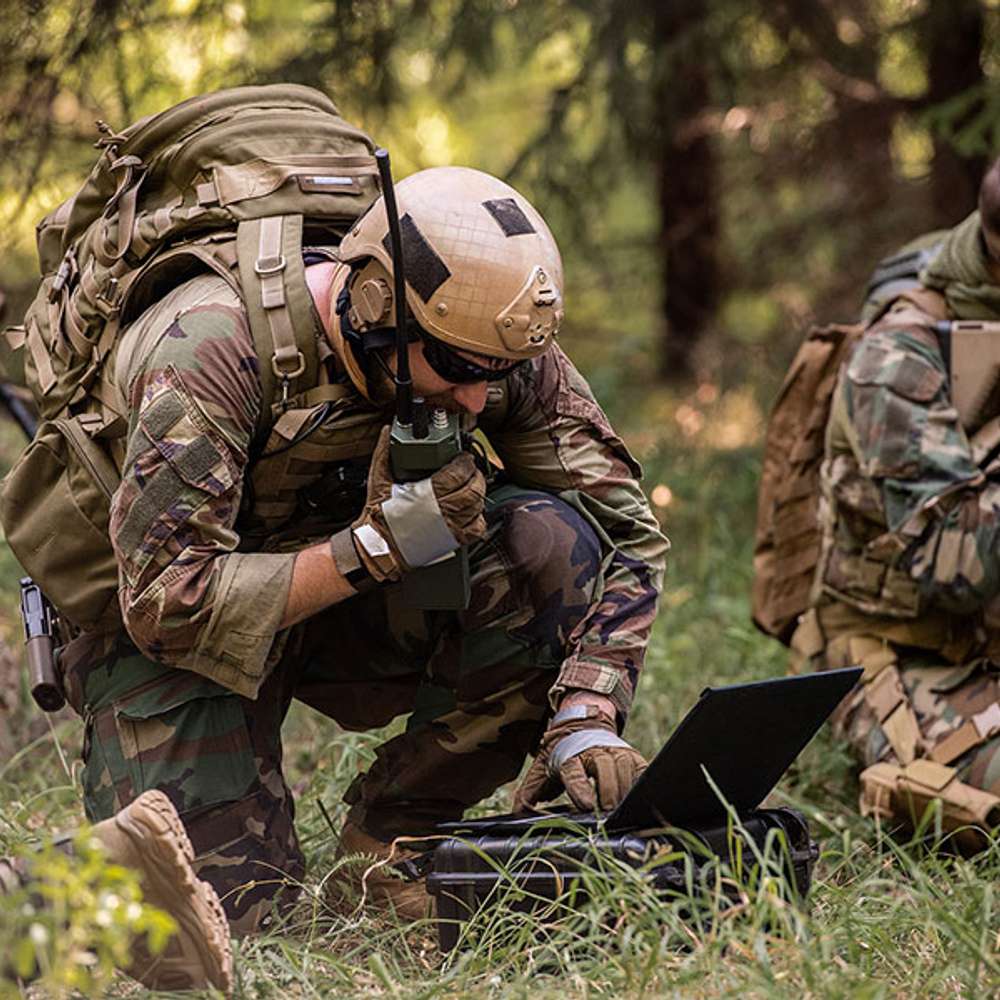
- Troops carry more electronics & battery weight affects fatigue & operation success
- High density electronics require clean, reliable & compact power
Smarter & More Compact Power Design To Solve Common Issues
Meeting high military demands requires careful engineering and design. The process requires a fundamental change to power architecture with topology selection, magnetics design, thermal management and material choice.
Wide bandgap semiconductors, such as silicon carbide and gallium nitride, have advanced what is possible for power density. They switch faster and run more efficiently than older silicon parts, which means less energy is lost as heat and smaller passive parts can be used in the design.
Thermal management is also vital. A compact power system that overheats in harsh conditions is not an effective power system. Innovative cooling strategies such as conduction cooling, thermal interface materials and smart load management mean that high performance power supplies can operate dependably in severe defence environments.
Qualification & Reliability Is Non-Negotiable
Lightweight power must not be fragile. Defence power systems must meet stringent environmental and EMC standards, including MIL-STDs and DEF-STANs, to ensure that they perform well under shock, vibration, temperature change, electromagnetic interference as well as electrical safety.
This is where specialist design, engineering, manufacturing and testing experience matters the most. Getting the balance between weight reduction and verified long life dependability takes deep knowledge and a good understanding of how a power system integrates into equipment.
Power Built For Current & Future Platforms
At On-systems we design and manufacture power modules and systems for defence, aerospace and marine applications. Our engineering team works as an extension to platform integrators and prime contractor teams to develop lightweight power systems that meet even the most demanding performance, environmental and qualification needs.
Are you ready to specify power for a new UAV programme, worn system, land or naval platform? We have the expertise to deliver innovative power that meets your requirements. Get in touch with us to discuss your project or find out more about our capabilities.